
CREATING VALUE

Start with us.
More value for your property.
We develop an integrated energy concept for your property, reduce running costs and improve your returns — creating a sustainable, future-ready property attractive to owners and residents alike.
Investment deduction & depreciationRunning costs
Energy & CO₂Higher
energy efficiency ratingSatisfied
residentsBetter
creditworthinessGreater
letting potentialPROPERTY VALUE
Your benefits as an owner
Better returns. Lower risks. Lasting value.
- Attractive return on equity
- Tax benefits, such as investment deductions and special depreciation*
- Use funding suited to your project
- Lower energy and CO₂ costs
- Optimised load profiles and intelligent energy management
- Improved energy efficiency rating
- Stronger creditworthiness and better financing prospects
- Lower vacancy risks and greater letting potential
- Increase and protect property value
- Readiness for future regulatory requirements
Benefits for your residents
More comfort. More predictable costs. Future-ready homes.
- Lower or more predictable energy costs
- Access to locally generated renewable energy
- Sustainable, efficient heating
- Charging infrastructure for electric vehicles
- Greater comfort through an improved building envelope
- More stable service charges and less exposure to energy prices
- An attractive, modern residential property that remains competitive
Our path to greater value
- 1Building assessmentAnalyse the building and identify potential
- 2Concept & financial viabilityCombine and prioritise measures
- 3Funding & taxesReview funding programmes and tax options for each project
- 4Delivery with partnersOrganise procurement and quality-controlled delivery
- 5Greater value & a stable futureLower costs, an attractive property and satisfied residents
* Tax effects such as the German investment deduction (IAB) depend on the circumstances of the owner and investment model. They are assessed individually with a tax adviser.
CONSIDER ELECTRICITY AND HEATING TOGETHER
One integrated system.
Many ways to optimise it.
Photovoltaics
Solar electricity from the roof
Yield depending on roof area, orientation and shading – first for consumption in the building, surpluses to the grid.
Energy management
Generation and demand
Storage and control bring solar power to where it is needed – checked against actual load profiles.
Homes, heating & charging
Households, communal electricity, heat pumps, electric mobility
Solar power for communal electricity, tenants, heat and charging – supplementary grid electricity remains part of the plan.
Photovoltaics can supply part of a heat pump’s electricity. Supplementary grid electricity remains important, especially in winter. We assess storage and coordinated controls against actual load profiles and additional costs, rather than adding them automatically to every system.
About the free initial assessmentTHE FINANCIAL PERSPECTIVE
Assess first.
Then examine in detail.
The first step costs you nothing: in a free initial video assessment (30–45 minutes) we discuss your goals and use your details and existing documents to assess which opportunities for photovoltaics, tenant electricity, heat pumps, charging infrastructure and – where appropriate – the building envelope are fundamentally suitable. A site visit, measurements and in-depth specialist planning are not included. If an on-site building audit makes sense, it is also free of charge in Berlin and Brandenburg; outside this area we agree the scope and any costs with you in advance.
Request a free initial assessment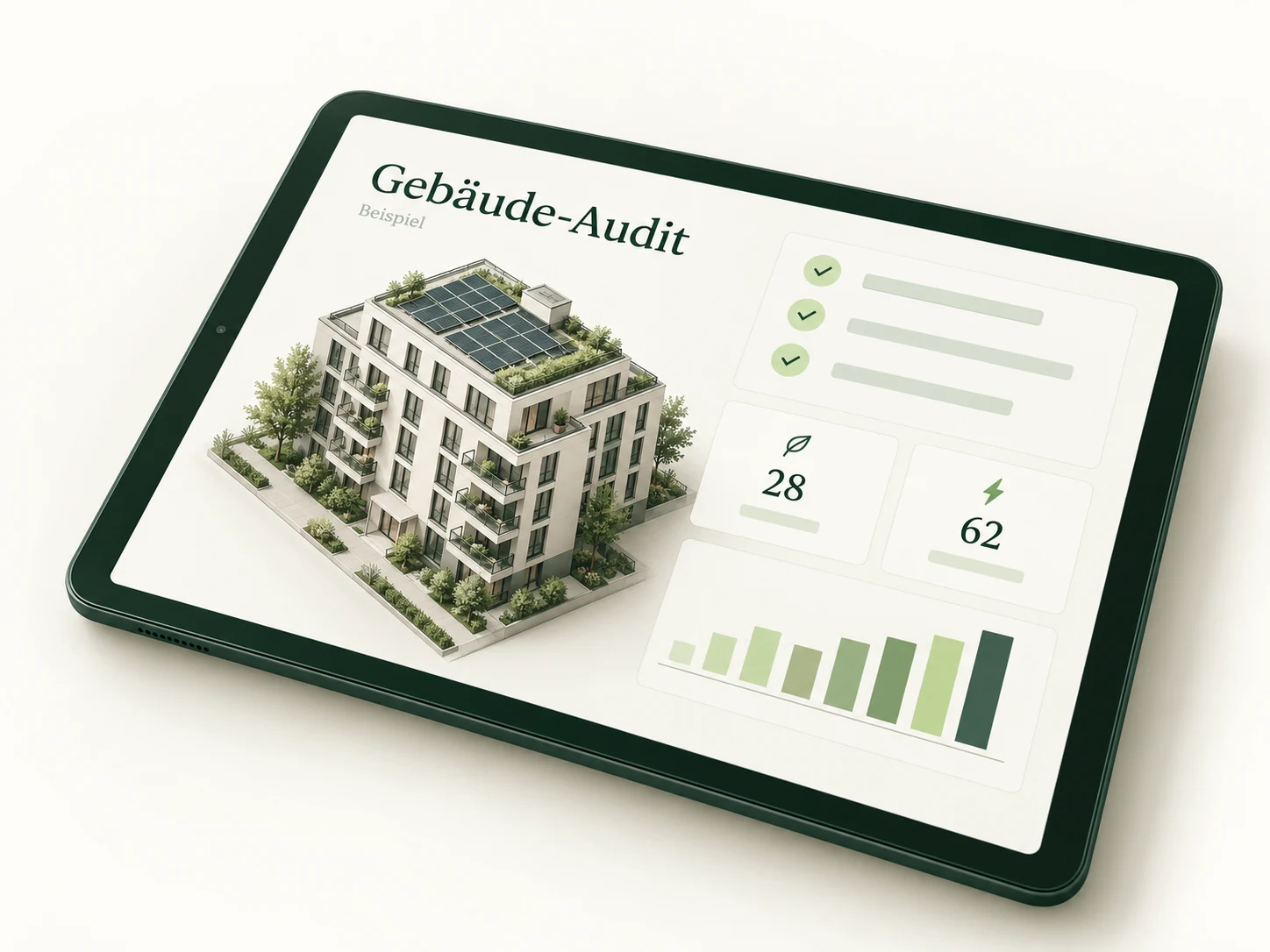
What does the on-site building audit provide?
We arrange the on-site building audit after the free initial assessment. It is free of charge in Berlin and Brandenburg; outside this area we agree the scope and any costs with you in advance. You receive the written report 10 working days after the site visit. We review roofs, heating supply, technical systems, energy consumption and available load profiles. The results are combined into an investment range, savings and revenue scenarios and a prioritised action plan. Funding opportunities and CO₂ impact are assessed for each project.
Which operating model suits the property?
Owner operation, roof leasing and system leasing differ in capital requirements, responsibilities and ongoing effort. Your goals and the building’s actual conditions guide the choice.
How is financial viability assessed?
The assessment covers investment and operating costs, expected generation, local consumption and potential revenue. Assumptions about prices, participation and financing are presented transparently.
How do electricity and heating work together?
A heat pump changes the building’s electricity demand. PV generation and heat demand are therefore assessed over time. Grid supply, hot water and existing systems are included in planning.
When are storage and energy management worthwhile?
We consider storage as part of the whole system of photovoltaics, heating, communal electricity and, where relevant, charging. Whether it is worthwhile depends on generation, consumption profiles, connection capacity and additional costs.
What role does the building envelope play?
Roofs, windows, façades and heat distribution influence energy demand. Relevant measures are coordinated with the energy concept and prioritised by impact, investment requirements and technical dependencies.
What matters for reliable operation?
Grid connection, metering, billing, maintenance and responsibilities must be coordinated. The services provided by each party are defined for the individual project.
Funding that fits your building.
Private owners of rented apartment buildings, condominium owners’ associations (WEG) and companies have different funding routes. Ownership, building use and the planned measure determine the appropriate programme.
Private owners & WEG
Heating replacement in existing residential buildings, including rented apartment buildings owned by private individuals. Basic funding covers 30% of eligible costs. Additional bonuses depend on personal circumstances and owner occupation. WEG applications distinguish common and individual property, and basic and additional applications.
Programme & requirements ↗Companies & residential buildings
For companies and other eligible organisations, such as a GmbH or GbR owning a residential building. The grant covers 30% of eligible costs. Eligible costs are capped; building and technical requirements must be met.
Programme & requirements ↗Solar electricity for tenants
Ongoing support per eligible kilowatt-hour supplied locally to tenants without using the public grid. The grid operator checks eligibility and pays the supplement. Surplus exports are treated separately. Rates and conditions depend on the installation and commissioning date. The shared building supply model under section 42b EnWG does not qualify for this supplement.
Programme & requirements ↗Regional funding is part of our service.
For your property’s location, we also review state and municipal programmes: eligible measures and applicants, deadlines, available funds and permitted combinations with federal funding or EEG support.
Berlin example: SolarPLUS S & L
SolarPLUS S primarily covers detached and two-family homes and terraced houses. SolarPLUS L targets larger projects such as apartment buildings, commercial properties and non-residential buildings, including projects by private landlords and condominium owners’ associations. Depending on the programme component, support covers storage, electrical systems and metering points, reports, studies and special PV solutions. The building must be located in Berlin; we check the specific requirements before commissioning work and starting the project.
SolarPLUS: scope & application ↗Our application support: clear steps and responsibilities.
Check the funding route
Together we review ownership, use, the planned measure and suitable funding. Mixed residential and commercial buildings require a separate assessment of the relevant building parts.
Coordinate documents
We help compile documents and coordinate specialist contractors or energy efficiency experts for the required technical confirmations (BzA and BnD).
Align application and implementation
KfW 458/459 applications must be submitted before the project begins. A supply or service contract with the prescribed funding condition and implementation date is required beforehand. Submission rights depend on the programme and applicant group.
Support the evidence process
We coordinate documentation after completion and, for tenant electricity, the required steps with the operator, metering and billing partners and grid operator.
The scope and price of our support are agreed in the quotation. Applications are submitted by the eligible applicant or an authorised representative where permitted; authorisation is not available in every case. Current programme conditions and available funds apply. We cannot guarantee funding approval.
Checked on 24 October 2026 · The funding bodies’ terms are authoritative.
Review funding in the initial assessment →Additional specialist services
Explore further where needed.
On request or where needed, qualified service providers can complement the assessment of your building. These services are optional and are not part of the free initial assessment.
- Thermography
- Blower door test
- Thermal bridge calculation
- Heating load calculation
- Hydraulic balancing
- Energy consulting / individual renovation roadmap (iSFP)
VOLQID identifies needs, obtains quotations from qualified service providers, compares scope and terms, and coordinates the process. You select and commission the service provider directly. Scope, costs and dates are agreed with the provider in advance.